2026 Best Ball Valve Manufacturers for Global Buyers
Choosing a ball valve manufacturer in 2026 means looking beyond brand recognition and unit price. MarketsandMarkets projected the global ball valves market to grow from USD 13.6 billion in 2023 to USD 17.0 billion by 2028. Its estimated compound annual growth rate was 4.6%. These figures describe a forecast, not confirmed 2026 sales. For global buyers, the practical challenge remains identifying suppliers whose documented capabilities match actual operating conditions. Details matter.
Valve specialist Philip L. Skousen, author of Valve Handbook, provides a technical foundation for evaluating these choices. Paraphrasing his application-based selection guidance: valve selection should reflect the service conditions and performance requirements. That principle becomes concrete when comparing a DN50 stainless steel valve against a high-pressure pipeline isolation valve. Buyers should examine pressure-temperature ratings, seat materials, operating torque, and material traceability. Where applicable, API 6D documentation, API 607 fire testing, and ISO 15848 fugitive-emissions qualifications deserve close attention. Check the scope. A certificate covering one product series does not automatically establish compliance across a manufacturer’s entire catalog.
This 2026 manufacturer guide therefore considers engineering capability, inspection records, delivery reliability, and support after installation. A credible shortlist should include evidence such as EN 10204 3.1 material certificates and documented pressure-test results. Still, published specifications leave gaps. Distributor responsiveness and spare-seat availability can be difficult to judge before the first order. An imperfect comparison is inevitable; unsupported certainty is avoidable. The strongest purchasing decision connects verifiable documentation with the buyer’s fluid, temperature, maintenance access, and required service life.
Ball Valve Types, Operating Principles, and Industrial Applications
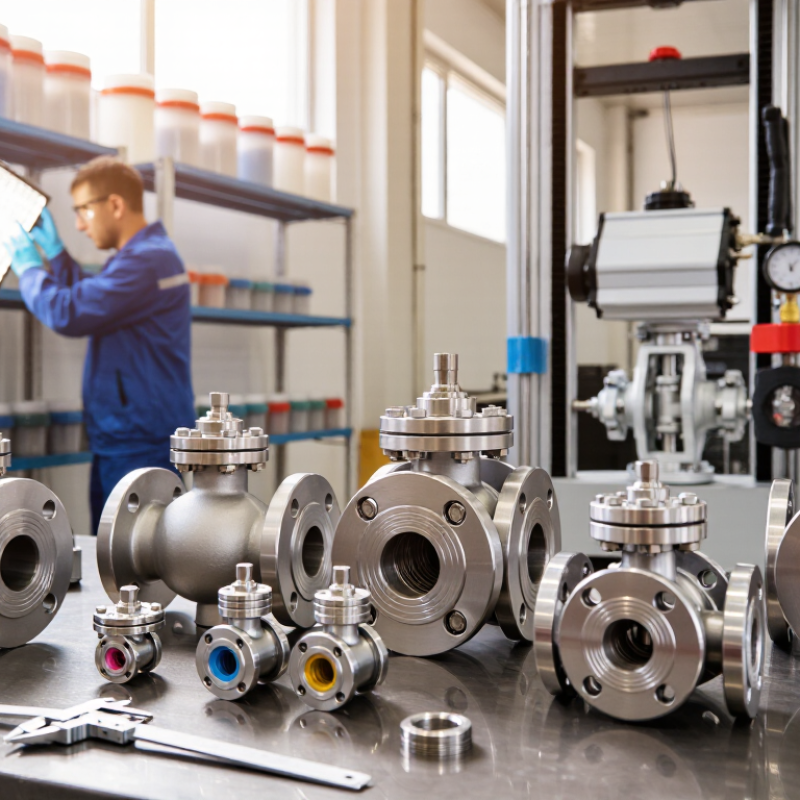
Ball valves control flow by rotating a bored ball through 90 degrees. When the bore aligns with the pipe, fluid passes through. A quarter-turn closes the passage against the seats. Floating balls rely on pressure to improve downstream sealing. Trunnion-mounted designs support the ball mechanically, helping reduce operating torque in larger valves. Full-port valves minimize flow restriction, while reduced-port designs offer a smaller flow opening. Three-way configurations can divert or mix compatible fluids, depending on their internal passages.
Industrial applications demand different materials and sealing arrangements. Stainless steel bodies are common in food processing, but corrosion resistance still depends on fluid chemistry. Carbon steel often suits compatible oil and utility services. Soft seats provide tight shutoff within specified temperature limits; metal seats can suit hotter or abrasive conditions. Selection involves tradeoffs. A metal seat may tolerate heat yet allow more leakage than a suitable soft seat. Standard ball valves also deserve caution in sustained throttling service, where concentrated flow can damage seats.
Tips: Check operating pressure, temperature, fluid composition, and cycling frequency before comparing manufacturers for a 2026 purchasing project. Ask for material traceability, pressure-temperature ratings, and documented shell and seat tests under an applicable standard such as API 598. Check actuator torque. A compact assembly may look economical, but maintenance clearance and replacement-seat availability deserve another look.
Criteria for Evaluating Ball Valve Manufacturers in 2026
Evaluating ball valve manufacturers in 2026 requires evidence beyond polished catalogs and competitive unit prices. Start with operating conditions: fluid composition, pressure, temperature, and expected cycling frequency. Details matter. For example, seawater service demands careful material selection because chloride exposure can cause localized corrosion. Request material certificates linked to heat numbers, dimensional inspection records, and pressure test reports. Check whether testing follows an applicable standard, such as API 598 or ISO 5208. An ISO 9001 certificate supports quality system assessment, but does not establish individual valve performance.
Manufacturing consistency deserves equal attention. Ask how suppliers control seat machining, stem alignment, assembly cleanliness, and final inspection. For automated valves, verify actuator sizing against documented operating torque and the specified safety margin. Where fire resistance is required, examine relevant fire test documentation and its coverage. Check the scope. A tested valve design may not cover every size, material, or seat configuration offered. Delivery estimates should include inspection scheduling, export packaging, and spare seat availability. These checks still leave uncertainty: samples cannot fully demonstrate long-term production consistency, and unusually detailed paperwork can obscure weak processes.
Tips: Send shortlisted suppliers the same technical questionnaire and request one traceable sample order. Compare documentation with the delivered valve markings. Record unanswered questions; an incomplete answer may deserve follow-up, while repeated inconsistencies warrant closer review.
Leading Ball Valve Manufacturers by Region and Specialization
Regional sourcing helps global buyers narrow their 2026 ball valve shortlist, but geography alone cannot establish manufacturing quality. North American suppliers are worth evaluating for project documentation, local technical support, and replacement availability within the region. For European manufacturers, examine capabilities in demanding applications, including cryogenic service, corrosive media, and fugitive emissions control. These are screening directions, not reliable descriptions of every factory within a region. Exceptions matter.
Across China, India, and other Asian manufacturing hubs, compare suppliers offering standard industrial valves, castings, forgings, and automated assemblies. A DN50 stainless steel valve for water service requires different evidence from a high-pressure valve handling abrasive slurry. Check material certificates, pressure-temperature ratings, seat compatibility, and documented shell and seat testing against the specified acceptance criteria. Prices need context. A lower quotation may exclude actuator mounting hardware, inspection charges, or export packaging, making the initial comparison misleading.
For buyers in the Middle East, regional assembly and service facilities may offer practical advantages when shutdown schedules are tight. Verify which operations happen locally and where pressure-containing components originate. Specialization deserves equal attention: cryogenic designs require suitable materials and extended bonnets, while abrasive service demands careful seat selection. Fire-safe claims should reference applicable test reports covering the offered design. This regional approach remains imperfect; a nearby warehouse cannot compensate for weak engineering or incomplete traceability. Ask shortlisted manufacturers for a sample inspection dossier before approving production.
2026 Best Ball Valve Manufacturers for Global Buyers - Leading Ball Valve Manufacturers by Region and Specialization
| Region | Common Manufacturing Strengths | Typical Product Specializations | Applications to Consider | Standards and Verification Points | Buyer Due Diligence |
|---|---|---|---|---|---|
| East Asia | A broad supplier base supports standard and customized valve production across multiple materials and sizes. | Floating and trunnion-mounted designs; threaded, flanged, and welded end connections; stainless-steel and carbon-steel options. | Water treatment, general industrial service, building systems, and selected oil-and-gas applications. | Check the applicable design and testing standards for the exact model; API 608 and ISO 17292 cover metal ball valves within their respective scopes. | Review material traceability, pressure-test records, production inspection plans, and whether the quoted configuration matches the required service conditions. |
| Europe | Suppliers serve diverse industrial markets, with product documentation and conformity requirements varying by destination and application. | Metal-seated and soft-seated valves; automated assemblies; options designed for process, chemical, and energy duties. | Chemical processing, power generation, water services, and industrial process control. | For European market access, determine which regulations and conformity-assessment requirements apply. Verify pressure equipment requirements against the product and intended use. | Request technical files, material certificates, operating limits, emissions information where relevant, and confirmation of the required conformity documentation. |
| North America | Products are commonly specified against established pipeline, process, and pressure-equipment requirements. | Pipeline ball valves, high-pressure designs, fire-tested configurations, and valves supplied with actuation packages. | Oil and gas, pipeline systems, refining, petrochemical facilities, and industrial utilities. | API 6D applies to pipeline and piping valves within its scope; API 6FA addresses fire testing of valves. Confirm the standard edition and product scope. | Check design pressure and temperature, end-to-end dimensions, fire-test evidence if required, inspection documentation, and actuator sizing. |
| India and South Asia | A varied manufacturing base supplies domestic infrastructure and export markets; capabilities differ by manufacturer and product line. | General-purpose flanged valves, stainless-steel and carbon-steel designs, and project-specific configurations. | Water and wastewater, power, chemical processing, and selected energy projects. | Specify the governing design, material, and test standards in the purchase documents; do not assume compliance from a regional origin alone. | Evaluate manufacturing capacity, quality-system certification, inspection access, export experience, and the ability to provide complete traceability records. |
| Middle East | Local supply and project support can be important for regional energy and infrastructure projects; manufacturing scope varies substantially. | Project-specified pipeline and process valves, including special materials or coatings when required by service conditions. | Oil and gas facilities, desalination, water infrastructure, and industrial projects. | Confirm project specifications, applicable API or ASME requirements, and any end-user approval requirements directly with the project documents. | Assess local service availability, spare-parts lead times, source inspection arrangements, and documented suitability for the process fluid and environment. |
| Global Selection Criteria | Product suitability depends on design details and verified performance rather than region alone. | Choose floating or trunnion-mounted construction, seat type, body material, trim, bore, connection, and actuation to match the duty. | Any application involving isolation or flow control where the selected valve design is suitable. | ASME B16.34 provides requirements for valve design, materials, dimensions, testing, and pressure-temperature ratings within its scope. Ratings depend on material, design, and applicable standard. | Provide pressure, temperature, fluid composition, solids content, cycle frequency, leakage requirements, installation details, and governing codes when requesting quotations. |
Important: This regional comparison is a buyer’s guide, not a ranking or certification of manufacturers. Capabilities vary by supplier and product series. Verify current datasheets, certificates, applicable standard editions, and project requirements before purchase.
Comparison of Materials, Certifications, and Performance Ratings
For global buyers comparing ball valve manufacturers in 2026, material selection deserves more attention than catalog rankings. The 2016 International IMPACT corrosion study estimated annual global corrosion costs at US$2.5 trillion, approximately 3.4% of global GDP. That figure covers all industries, but it highlights the financial importance of corrosion control. Carbon steel often suits noncorrosive oil and gas service. Type 316 stainless steel typically contains 2–3% molybdenum, improving resistance to localized corrosion. Chloride concentration and temperature still matter. Seawater service requires closer scrutiny.
Verify the paperwork. ISO 9001 certification addresses quality management; it does not establish a valve’s pressure rating or leakage performance. Request material certificates identifying heat numbers, chemical composition, and mechanical properties. Match those heat numbers against markings on the supplied valves. For applicable steel valves, API 598 generally requires hydrostatic shell testing at 1.5 times the pressure rating at 38°C. An ISO 5208 Rate A claim means no visually detectable leakage during the specified test. Test conditions matter.
Compare pressure and temperature together. Under ASME B16.34, a Class 150 valve with an ASTM A216 WCB body is rated at 285 psi at 38°C. Its allowable pressure decreases as temperature rises. Seats can impose lower operating limits than the metal body. For emissions-sensitive service, request ISO 15848-1 qualification showing leakage class, temperature class, and endurance cycles. One weakness in this comparison is that laboratory qualification cannot predict every operating condition. A clean-water test says little about sand damaging seats during repeated operation.
2026 Ball Valve Buying Guide: Material Pressure Ratings Compared
Compare reference pressure ratings for two common cast ball valve body materials: ASTM A216 WCB carbon steel and ASTM A351 CF8M stainless steel. The chart shows ASME pressure classes at 100°F (approximately 38°C).
What the ratings show: WCB has slightly higher reference pressure ratings at this temperature. CF8M is a cast molybdenum-bearing stainless steel commonly selected for improved corrosion resistance in suitable process media. Pressure class is a designation: a Class 150 rating does not mean a universal 150 psi working-pressure limit.
What global buyers should verify: These values describe standard material pressure–temperature ratings, not a guaranteed working pressure for every complete ball valve. Seats, seals, valve design, service temperature, and applicable product standards can reduce the allowable operating pressure. Request the supplier’s pressure–temperature curve, material certificates, and inspection records. Where required, verify fire-test qualification to API 607 and fugitive-emissions qualification to ISO 15848-1 for the relevant valve design and scope.
Reference basis: ASME B16.34 pressure–temperature ratings for material groups 1.1 (ASTM A216 WCB) and 2.2 (ASTM A351 CF8M), at 100°F. Values are in psi. Confirm the applicable standard edition and product rating before procurement. This is a technical reference comparison for 2026 purchasing, not a manufacturer ranking or a dataset of newly measured 2026 performance.
Global Sourcing Factors: Pricing, Lead Times, and After-Sales Support
Choosing ball valve manufacturers for 2026 requires comparing total purchasing costs, delivery commitments, and documented after-sales support. Request matching specifications before comparing prices: DN50, PN40, 316 stainless steel, PTFE seats, and EN 10204 3.1 material certificates. Separate valve prices from inspection, export packaging, freight, duties, and spare parts. Specify the Incoterm and named destination. A cheaper quotation can still tempt buyers, even when its exclusions remain unclear. That temptation deserves scrutiny. Ask how long quotations remain valid and whether material substitutions require written approval.
UNCTAD’s Review of Maritime Transport 2024 reports that maritime trade volumes increased 2.4% in 2023. The same report notes that shipping carries over 80% of world merchandise trade by volume. These historical figures provide shipping context; they do not establish a supplier’s 2026 delivery reliability. Delays compound. Request separate dates for casting procurement, machining, assembly, pressure testing, and dispatch. For a 200-valve order, ask whether partial shipments are available and how additional freight is charged. Treat an unverified delivery promise as an estimate.
After-sales support needs measurable commitments, especially when valves serve plants far from the factory. Request a sample warranty procedure, installation instructions, and an illustrated spare-parts list before ordering. Specify requirements for replacement seats, stem seals, and actuator mounting compatibility. Details matter. Agree on response times, claim evidence, and responsibility for replacement freight. A 24-month warranty offers limited practical value if its start date and exclusions remain ambiguous.
Related Posts
-
China Best Ball Valve Manufacturers for Global Buyers
-
What Is the Best Ball Valve Manufacturer in China?
-

Top 10 Electric Valve Benefits for Industrial Applications You Should Know
-
What Is an Electric Valve and How Does It Work?
-
China Top Electric Valve Manufacturers for Global Buyers
-
Why Choose a Pneumatic Valve for Industrial Automation?