
How to Choose an Online Checkweigher for Your Business?

Choosing an online checkweigher is a practical decision about product quality, line speed, and day-to-day reliability. A machine that looks suitable in a brochure may behave differently beside a fast conveyor or with a changing product mix. That matters. Before comparing models, define the package weight range, target throughput, available belt space, and required weighing accuracy. Checkweigher Online options should be assessed against these real operating conditions, not just headline specifications.

Consider how each unit handles your products, from small pouches to heavier cartons. Ask suppliers to test representative samples at your intended line speed. Verify the reject mechanism, including whether it can remove an underweight pack without disturbing neighboring items. Small details count. Check the conveyor dimensions, cleaning requirements, display usability, and compatibility with existing production equipment. If weight records need to support quality checks, confirm what data the system stores and how staff can retrieve it. No model is perfect, and a technically capable unit may still be awkward to maintain. Request clear information on calibration, operator training, spare parts, and service response times. Comparing these points helps you choose a checkweigher that fits your production line and remains dependable after installation.
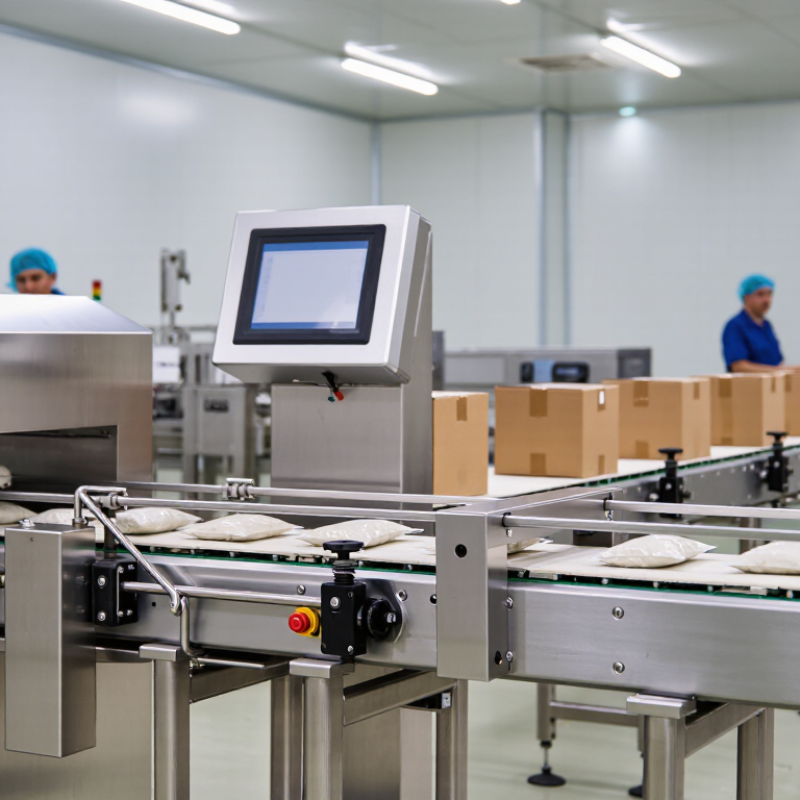
How to Choose an Online Checkweigher for Your Business?

Identify Your Product, Throughput, and Weighing Requirements

Start with the product itself. Record its weight range, length, width, height, and package type. A soft pouch behaves differently from a rigid carton on a moving belt. Check whether products arrive evenly spaced or occasionally touch. Small details matter.

Then estimate normal and peak throughput, not just the average. Count units per minute during the busiest production window. Compare that figure with the checkweigher’s rated speed, and ask how accuracy changes at that pace. A line running 120 packs per minute may need extra capacity for uneven spacing or brief surges. Not always obvious.

Define the weighing requirement before comparing equipment. Specify target weight, acceptable variation, and the smallest difference the process needs to detect. Consider belt width, vibration, washdown routines, and available floor space, too. These conditions can affect stable readings as much as the scale itself. I have seen plans focus heavily on speed, then overlook product transfer onto the weighing belt. That estimate may need revisiting. Ask for a trial using real products at realistic line speeds, and review rejected-pack handling and production data needs. A practical trial can expose gaps that a specification sheet will not.

Match Checkweigher Capacity and Accuracy to Your Production Line

How to Choose an Online Checkweigher for Your Business?

Match Checkweigher Capacity and Accuracy to Your Production Line

Start with the packages you actually produce. List the lightest and heaviest items, their target weights, and the line’s usual speed. A checkweigher’s maximum capacity is not the same as its ideal working range. Selecting a unit that is oversized for small packs may make fine weight differences harder to detect. Small details count. Include trays, labels, and closures in the test weight, not just the product.

Accuracy should match your permitted weight variation and the natural differences between products. A bag of irregular pieces may fluctuate more than a uniform carton. Ask for test results using your own products, packaging, and operating speed. Check whether readings remain consistent across several runs, including after a changeover. A brochure figure alone cannot show how your line behaves. Be cautious about promising tighter control than the product and process can reliably support.

Throughput matters too. Measure the space between packs and confirm the scale can weigh each item without overlap or missed readings. Consider vibration, belt condition, and nearby equipment; these can affect stability. Test the reject device with actual packages, since a correct reading is only useful if the right item is removed. A trial may reveal awkward timing or setup issues, and that is worth noticing before installation. Keep a record of test conditions so later comparisons are meaningful.

Evaluate Conveyor Layout, Controls, and System Integration

A checkweigher should fit the line you have, not the line shown in a catalog. Measure conveyor height, belt width, product spacing, and available floor space before comparing models. Watch the transfer points. A small gap or height change can make lightweight packs bounce, producing unstable readings. Leave room for safe access and routine cleaning, too.

Controls matter during real production, not just during a demonstration. Operators should be able to adjust product settings, review weight trends, and respond to alarms without digging through confusing menus. Check whether recipes can be selected clearly when package sizes change. A useful test is to ask an operator to complete a routine changeover. If the steps feel awkward, they probably will on a busy shift. Keep it practical.

System integration can be the hardest part. Confirm how the checkweigher will exchange signals with upstream fillers, reject devices, and plant reporting systems. Ask which data formats and communication options are supported, and test the reject confirmation signal with actual products. For example, a narrow conveyor may require a compact reject mechanism, while fragile packs may need gentler handling. In my experience, drawings help, but they rarely reveal every cable route or pinch point. Allow time for an on-site review. Even then, a few details may need revisiting after installation.

How to Choose an Online Checkweigher for Your Business? — Evaluate Conveyor Layout, Controls, and System Integration
Evaluation Dimension Compact or Low-Speed Line General-Purpose Line High-Speed Line What to Verify
Typical application Small cartons, jars, pouches, or short production runs Routine packaged-goods production with frequent changeovers Continuous, high-volume packaging with stable product flow Confirm the actual product, packaging material, and production schedule.
Indicative throughput About 30–100 packages per minute About 100–250 packages per minute About 250–400+ packages per minute Ask for a product-specific test at the target speed; package length and spacing affect achievable throughput.
Conveyor layout Short infeed and weighing belts; suitable for space-limited lines Separate infeed, weigh, and reject sections for controlled spacing Longer infeed and settling zones may be needed to stabilize product flow Measure available length, width, elevation, transfer gaps, and access for cleaning and maintenance.
Product dimensions and weight Typically suited to compact, consistently oriented packs Can accommodate a wider range of pack sizes with suitable belt changes Best for products that can be conveyed at consistent spacing and orientation Provide minimum and maximum package length, width, height, and gross weight before specifying the system.
Weighing performance May allow longer weighing time for individual products Balances measurement performance with production rate Requires careful control of vibration, spacing, and belt speed Request validated results using representative products. Dynamic accuracy depends on product, speed, environment, and setup.
Reject and reject confirmation Air blast or simple pusher may suit light products Choose a reject device matched to product weight and conveyor speed Use a high-speed reject mechanism with product tracking and reject confirmation Check reject timing, reject-bin capacity, guarding, and what happens if a reject is not confirmed.
Controls and operator interface Basic recipe selection, weight display, and alarm history Recipe management, role-based access, and production reporting Fast recipe changes, live status, diagnostics, and line-level data exchange Review user access, language needs, audit records, alarm handling, and ease of product changeover.
System integration May operate independently or provide simple status outputs Can exchange line status, reject signals, and production counts Often needs coordinated communication with upstream and downstream equipment Confirm available I/O and supported communication protocols with the site controls team before purchase.
Environment and construction Specify construction for the actual washdown and dust conditions Consider corrosion resistance and tool-free belt removal where needed Confirm the frame, electrical enclosures, and components suit the production environment Define cleaning method, moisture exposure, temperature, dust, and any applicable hygiene requirements.
Installation and validation Check floor space, power, and conveyor height Plan line stops, mechanical interfaces, and product trials Coordinate controls, guarding, and commissioning with the full line Agree acceptance criteria, test products, operating speed, documentation, and operator training in advance.

Planning guide only: throughput and weighing performance are indicative and must be confirmed through testing with the actual product, packaging, conveyor layout, and operating conditions.

Compare Inspection Features, Compliance, and Data Options

How to Choose an Online Checkweigher for Your Business?

A checkweigher should suit your product, package, and line speed—not just its target weight. Ask whether it can identify underweight and overweight packs across your real operating range. A reject device also needs confirmation; otherwise, a missed ejection may go unnoticed. Test with actual packs, including light cartons, damp labels, or products that shift on the belt. Small details matter. Compare inspection features against likely faults instead of paying for every available option. I would not assume a faster system is better if it creates frequent false rejects.

Compliance depends on your product and operating market, so confirm applicable requirements with a qualified specialist. Look for clear calibration procedures, documented routine checks, and traceable results. Data options deserve the same scrutiny. Can operators export records, review timestamps, and see who changed settings? Will the system connect with existing production software, or is a simple file export enough? A polished dashboard is not useful if staff cannot retrieve yesterday’s readings quickly. Be realistic about storage and access needs; it is easy to overestimate how much data a team will review.

Assess Supplier Support, Total Cost, and Validation Needs

When evaluating an online checkweigher, look beyond the quoted machine price. Ask who handles installation, operator training, and fault diagnosis after commissioning. A useful supplier can explain expected response times and identify which spare parts should be kept on site. That matters. If a sensor fails during a busy shift, slow support can cost more than the original price difference.

Calculate total cost over the equipment’s working life. Include installation, software or service fees, preventive maintenance, spare parts, and downtime. Check whether the conveyor and reject device suit your product size and line speed. A compact machine may look economical, but awkward integration can require extra guards or conveyor changes. Those details are easy to underestimate. Request a written estimate that separates required costs from optional services.

Validation should reflect real production, not just a successful demonstration. Ask how the supplier will test accuracy across your product weight range, line speed, and packaging conditions. Agree on acceptance criteria and keep records of test weights, results, and adjustments. For example, a stable carton on a showroom belt may behave differently when damp packages arrive close together. It is tempting to accept a neat test report and move on; that can be a mistake. Confirm who repeats the checks after installation and when recalibration is recommended.